
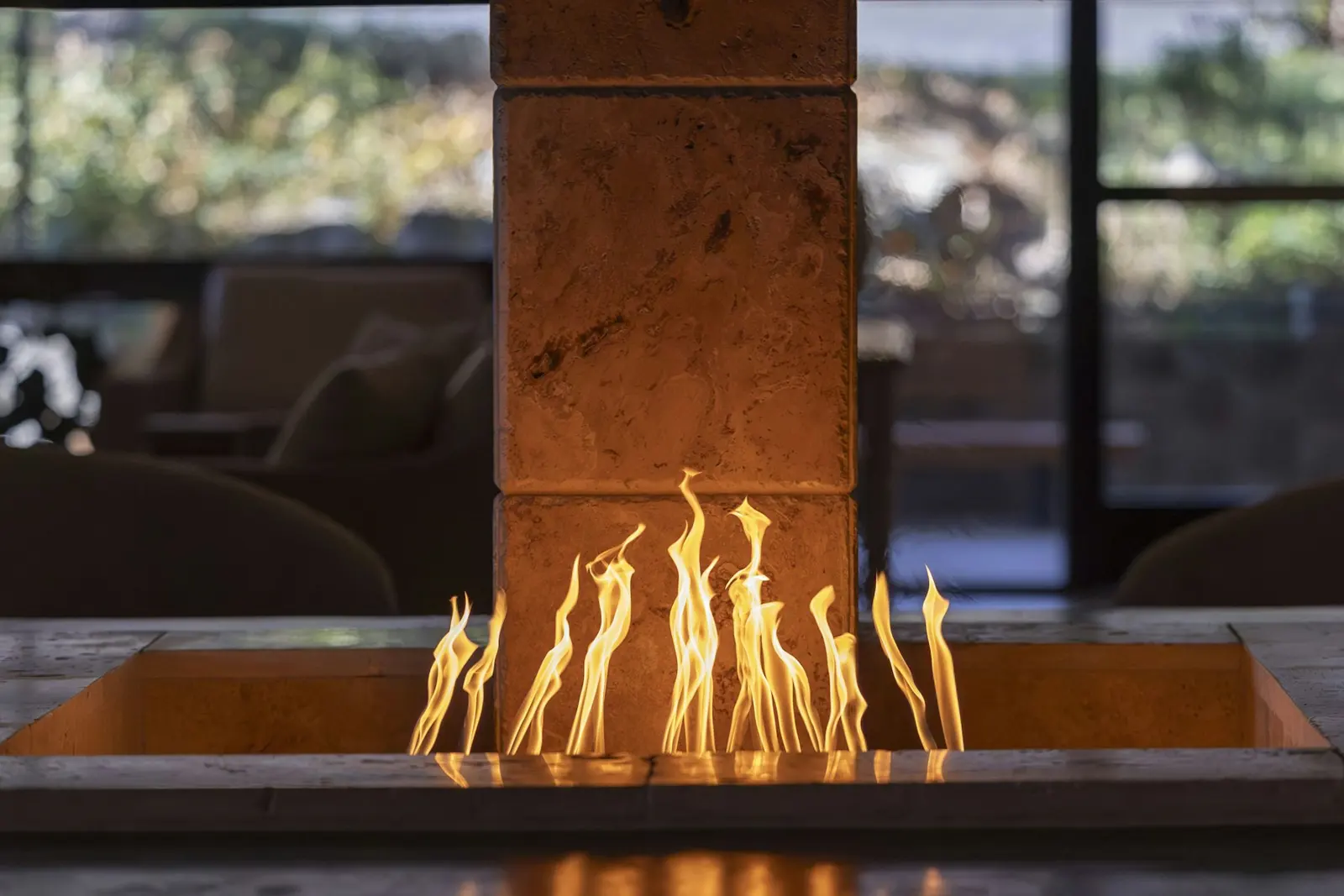
My gas fireplace clicks but won't light — what's wrong?
The clicking is the igniter sparking, so the electronics are at least partly working; the problem is that the gas isn't catching, or the control isn't sensing the flame. On the first cold nights of the season the usual reasons are air in the pilot line after months off, a shut-off valve left closed, a spark electrode or pilot fouled with summer dust and spider webs, or batteries strong enough to spark but too weak to finish the lighting sequence. If a couple of tries don't light it, stop and have it checked; most of these repairs run $150 to $450.
Scottsdale Chimney · November 6, 2026
What the clicking tells you
Most newer gas fireplaces, including the linear and glass-front units in many Scottsdale homes, have electronic ignition. When you press the remote or wall switch, a control module sends a fast series of sparks to the pilot. Once it sees a pilot flame, it opens the main burner. The clicking you hear is those sparks. If it keeps clicking and nothing lights, the module is still waiting for a flame it never gets. Many units stop after a set time and lock out, so the fireplace may then do nothing at all until the power or batteries are reset.
Older fireplaces with a push-button igniter work the same way on a smaller scale: each click is one spark, and you hold the gas knob in while you click.
Why it shows up in November here
In the northeast Valley a gas fireplace often sits off from spring until the first cool evening of fall. The summer works against it. Arizona's monsoon season runs June 15 to September 30, the window the National Weather Service has used since 2008, as the University of Arizona's CLIMAS climate program explains. The wind and dust that come with those storms push fine grit into outside vent terminations and onto the burner. Spiders like the quiet pilot area and spin webs across the pilot hood. A thin coat of dust on the spark electrode, or a web in the pilot opening, is enough to stop a spark from lighting the gas.
The usual causes
- Air in the pilot line: after months unused, the line can hold air, so the first sparks hit nothing that will burn. Fireplace manuals list air in the gas line as a cause of a pilot that won't light.
- Gas turned off: the shut-off valve near the fireplace, often behind the lower grille or in a floor box, was closed at some point and never reopened.
- Out of propane: in homes that run on propane rather than natural gas, a low or empty tank gives exactly this symptom.
- Dirty or worn electrode: dust, rust or a cracked ceramic insulator weakens the spark or sends it to the wrong spot.
- Blocked pilot: dust or a spider web in the small pilot opening starves the flame.
- Weak batteries: the receiver or battery backup pack can have enough charge to click but not enough to hold the valve open and sense the flame.
- Flame sensing: the pilot lights for a second and goes out, because the module can't confirm the flame. That points to the sensor, the module, or the wiring between them.
What you can safely check
- Read the lighting instructions on the plate inside the lower grille and follow them for your model, not a generic video
- Make sure the gas shut-off valve is open; the handle runs in line with the pipe when it is open
- Put fresh batteries in the remote, the receiver and any battery backup pack
- On propane, check the tank gauge
- Some owner's manuals, such as FMI's, say to hold the control in the pilot position for two to three minutes to purge air; only do this if your own manual says so
- Give it two or three tries, then stop. Don't let it click for minutes on end, and don't reach in with a lighter unless your manual includes a match-lighting procedure
When to stop, and what the repair costs
If you smell gas at any point, stop. Leave the house, don't touch light switches, and from outside call 911 and Southwest Gas at 877-860-6020, the day-or-night number in Southwest Gas's own safety materials. On propane, call 911 and your propane supplier.
Otherwise, if fresh batteries and an open valve don't fix it, a technician cleans the electrode and pilot, checks the spark gap, gas pressure and flame sensing, and tests the module. In Scottsdale an igniter or remote receiver repair runs $200 to $450, pilot, thermocouple or thermopile work $150 to $350, and a gas valve or control board $400 to $1,200. The diagnostic visit is free, and the exact price is written before any work. If it hasn't been serviced in a year, a yearly gas fireplace service at $150 to $350 often clears this along with everything else.
FAQ
More answers
Is it dangerous if my gas fireplace keeps clicking without lighting?
The clicking itself isn't dangerous, but repeated tries can let a little unburned gas collect in the firebox. Stop after two or three attempts, wait a few minutes with the glass on, and call for service. If you smell gas, leave first and call 911 and Southwest Gas.
Why does the pilot light but the main flames never come on?
Then the spark is doing its job. The control isn't sensing the pilot flame, or it isn't sending power to open the main valve. A dirty sensor, a weak battery backup, the module or the wall switch wiring are the usual suspects.
My outdoor fire pit clicks but won't light. Same problem?
Often, yes, and outdoor units see more of it because sun, wind and storm water reach the electrode and pilot directly. Let a wet pit dry fully before trying again.
Can I light it with a long lighter instead?
Only if your owner's manual includes a manual lighting procedure for your model. Many direct-vent fireplaces are not meant to be lit that way, and lighting it by hand doesn't fix the fault that stopped the spark from working.
Keep reading
More from the blog
 My gas fireplace pilot won't stay lit — why?Why a gas fireplace pilot lights then goes out, or stays on while the burner won't light — the usual parts, what you can check, and Scottsdale repair prices.
 Do gas fireplaces need to be cleaned and serviced?Gas fireplaces burn clean but still need a yearly check. What a gas fireplace service includes, why Valley dust matters, and what it costs in Scottsdale.
 Why is there a white film on my gas fireplace glass?Why the glass on a gas fireplace gets a cloudy white haze, how to clean it safely, and when the film or soot means something is wrong.
Book online
Pick a day. We bring the answers.
Free inspection in a 3-hour window: 8 to 11, 11 to 2, or 2 to 5. We call to confirm before we arrive.